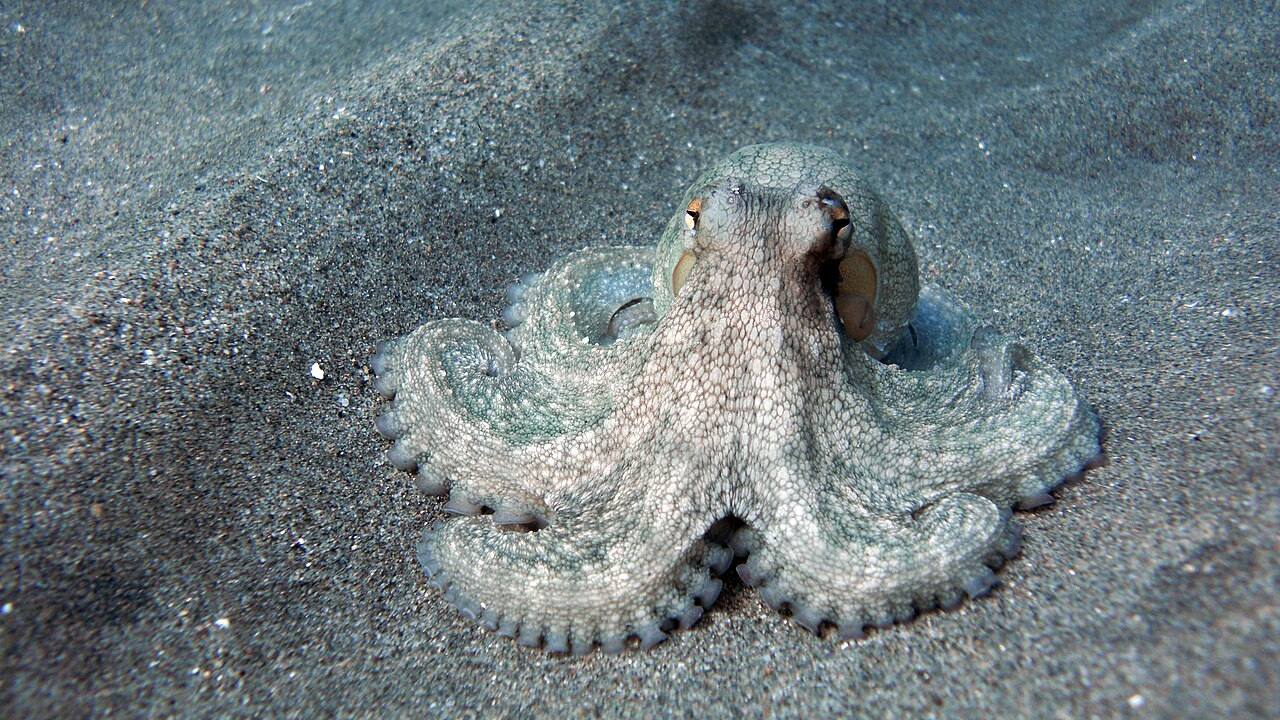
Three Hearts, One Clever Problem
Humans move oxygen using iron-based hemoglobin — the reason our blood is red. Octopuses instead use hemocyanin, a copper-based molecule that turns their blood blue. The catch: hemocyanin carries oxygen far less efficiently, especially in cold seawater. Evolution's fix was to split the pumping job across three separate hearts instead of one. Two small branchial hearts push blood through each gill to pick up oxygen; a third, larger systemic heart then drives that oxygenated blood out to the rest of the body.
A 2024 study on Octopus maya examined what happens to the systemic heart under heat stress, since ocean warming is becoming a real threat to marine life. Researchers measured the heart's mitochondria — its power plants — at three temperatures (24°C, 26°C, and 30°C) and found that warming disrupts the organ's oxidative phosphorylation and antioxidant defenses, the chemical machinery that keeps heart cells supplied with energy while managing cellular stress. In short, as waters heat up, the octopus's most vital pump struggles to keep its own engine running cleanly.
This matters beyond octopus biology. It's a preview of how climate warming can quietly undermine an animal's core physiology long before it becomes visibly sick.
A Brain Split Into Nine Pieces
While the heart pumps blood, the octopus brain does something equally unconventional: it delegates thinking. Roughly two-thirds of an octopus's half-billion neurons live not in its head but scattered through its eight arms, organized in a "distributed" nervous system rather than one central command post.
Inside the actual brain, scientists have long been fascinated by a structure called the vertical lobe, the seat of learning and memory. A landmark 2023 study published in eLife mapped this structure's wiring at the level of individual neurons using serial electron microscopy — essentially building a wiring diagram, or "connectome," of a memory network for the first time in any octopus. The team discovered the vertical lobe uses a strikingly simple, one-way (feedforward) circuit: about 25 million small interneurons called amacrine cells receive input from sensory pathways and funnel it toward a much smaller set of output neurons. One synaptic junction in this circuit shows long-term potentiation — the same strengthening-with-use process that underlies memory formation in the human hippocampus. Two independent lines of evolution, separated by roughly 700 million years, appear to have converged on a similar memory-storing trick.
Separately, a 2022 study in Nature Communications used single-cell gene-reading technology to catalog the different cell types inside a developing octopus brain. The researchers found that beyond neurons, the brain contains multiple types of support cells (glia) that share genetic signatures with glial cells in mice and fruit flies — hinting at ancient, shared rules for how any complex brain, vertebrate or not, is built. They also found that memory-related genes in the vertical lobe resemble those in the learning centers of a fly's brain, reinforcing the idea of convergent design.
Even the octopus's earliest development is unusual: a 2021 eLife study tracked how neurons are born in octopus embryos, discovering that new brain cells originate far outside the central brain, near the eyes, and migrate long distances inward to build the final structure — a strategy reminiscent of how vertebrate brains, including ours, assemble themselves.
Why It Matters
An octopus is not simply a weird sea creature; it's a natural experiment in alternative solutions to universal biological problems. Three hearts solve the oxygen-delivery problem that we solve with one four-chambered pump. A distributed nervous system solves the "how do I control eight independent, boneless arms" problem that we never had to face. Yet, at the finest scale — memory circuits, cell types, developmental migration — cephalopod brains keep echoing solutions found in mice, flies, and humans.
Studying how the octopus's heart handles rising ocean temperatures, and how its brain organizes memory without a single central hub, offers scientists a rare comparative mirror — one that could eventually inform everything from climate-resilience biology to the basic principles of how any brain learns.