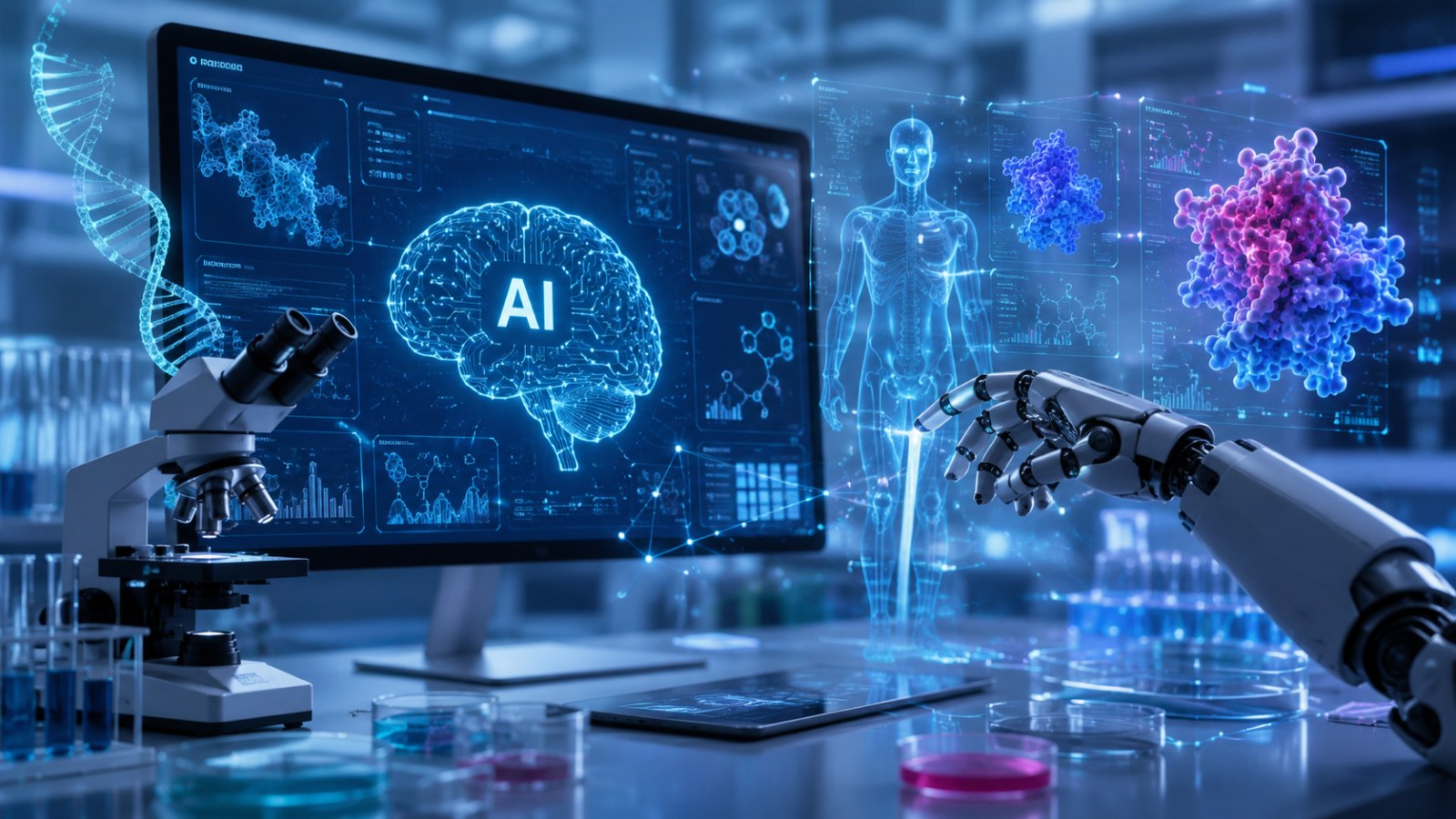
From chatbots to lab partners
For years, AI in biology meant one thing: prediction. Feed it a protein sequence, get back a 3D shape. Feed it an X-ray, get back a diagnosis probability. Useful, but passive — the human still had to plan the experiment, run the analysis, and stitch the story together.
That's changing. A team at Stanford University, led by computer scientist Kexin Huang and colleagues across Stanford's Departments of Genetics, Pathology, and Computer Science, built something different: an AI agent that doesn't just answer questions but carries out entire research workflows on its own. Called Biomni, it was trained by mining tasks, tools, and protocols out of thousands of recent bioRxiv papers spanning 25 biomedical subfields, then packaged into a working environment stocked with over 100 software tools and nearly 60 databases the system autonomously executes a wide spectrum of research tasks across diverse biomedical subfields by mining essential tools, databases, and protocols from tens of thousands of publications. In practice, this means a scientist can type a plain-English question — "why are these patients responding differently to the drug?" — and the agent plans the analysis, writes the code, runs it, and comes back with an answer, the same way a skilled postdoc would Biomni digs into the scientific legwork after understanding a simple natural-language question, and in one real case cleaned and unified over 450 files of glucose, food, and activity data to identify patterns in just 40 minutes. It's freely available for researchers to try at biomni.stanford.edu. bioRxivStanford University
Editing genes with a conversation
Gene editing is powerful but unforgiving — a single mistake in guide RNA design can waste weeks of lab work. Researchers have now built CRISPR-GPT, a tool that automates the planning of CRISPR gene-editing experiments the way an experienced genome engineer would, published in Nature Biomedical Engineering. It walks scientists through selecting the right editing strategy, designing guide RNAs, and predicting off-target risks, turning what used to require deep specialist expertise into a guided, conversational process.
A universal translator for medical data
Hospitals generate a flood of different data types — scans, lab reports, genetic profiles — that rarely talk to each other. A team led by Kai Zhang and colleagues, including researchers at Lehigh University, built BiomedGPT, a single AI model trained to handle many of these data types at once rather than needing a separate specialist model for each BiomedGPT is a generalist vision-language foundation model built for diverse biomedical tasks, demonstrating that effective training with diverse data can lead to more practical biomedical AI for improving diagnosis and workflow efficiency. The code is open-source, meaning any academic lab can build on it rather than starting from scratch.
Why this matters beyond the lab bench
A recent review in Nanomaterials frames the bigger picture: these tools work because they combine imaging, genetic, and health-record data into one coherent picture instead of analyzing each in isolation multimodal AI is driving a paradigm shift in modern biomedicine by seamlessly integrating heterogeneous data sources such as medical imaging, genomic information, and electronic health records across biomaterials science, medical diagnostics, and personalized medicine. That integration is exactly what turns a data pile into a diagnosis, or a hunch into a testable hypothesis.
None of these tools replace scientific judgment — Biomni's own creators note it still struggles with nuanced clinical reasoning and truly novel experimental thinking. But for the repetitive, data-heavy grind that eats up most of a researcher's week, the lab partner has arrived, and it doesn't sleep.
Where to access them
Biomni — free web platform: biomni.stanford.edu
BiomedGPT — open-source code available via the authors' public repository, described in Zhang et al., Nature Medicine (2024)
CRISPR-GPT — described in Qu et al., Nature Biomedical Engineering (2025)