The pitch: nature's hard drive
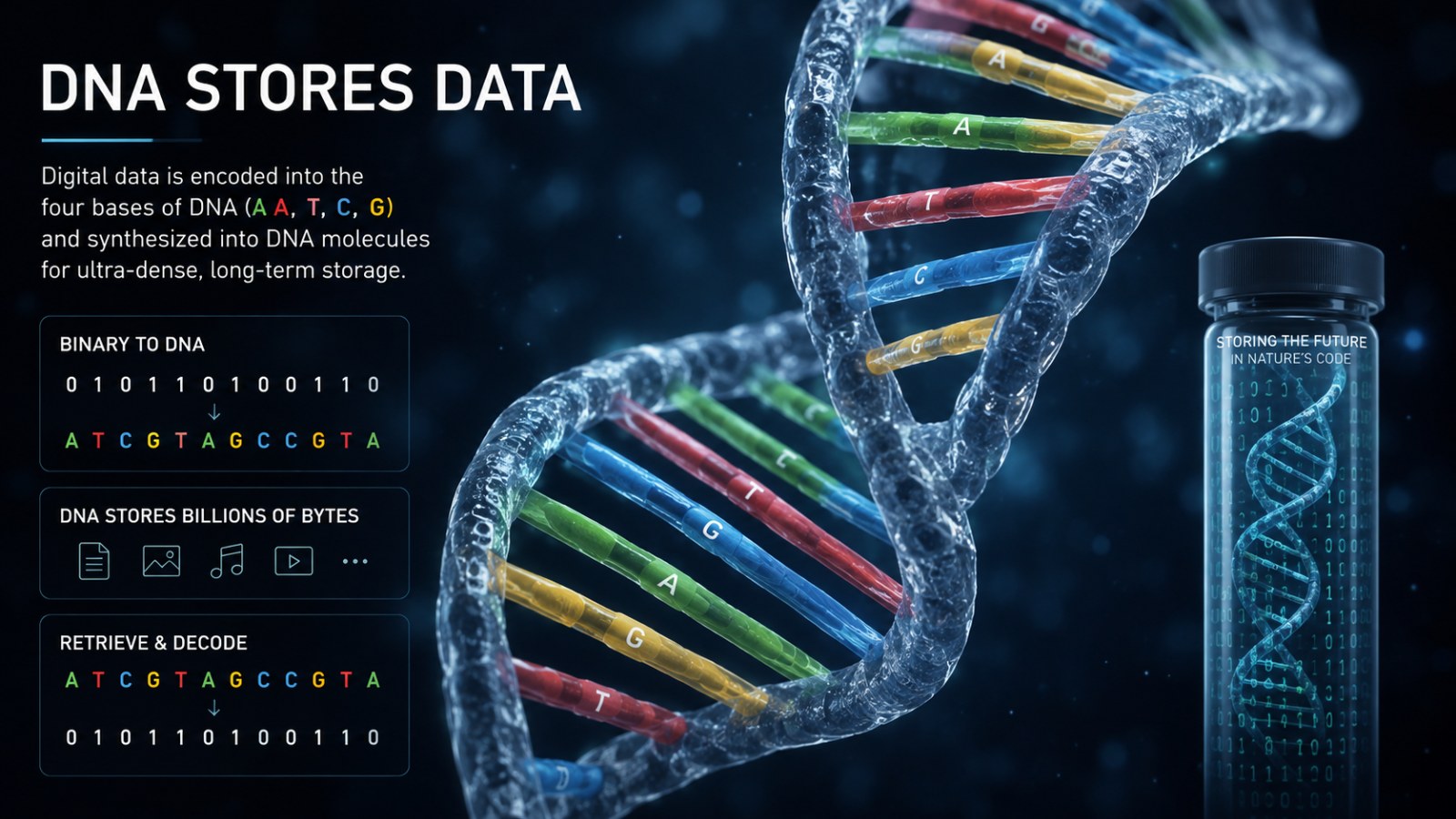
Every cell in your body already uses DNA to store the "operating instructions" of life, packed into a space invisible to the naked eye. Researchers realized the same molecule could store any digital information — a computer file is just a string of 0s and 1s, and DNA is just a string of four letters (A, T, C, G). Swap one code for the other, and you have a storage medium.
The appeal is staggering density and shelf life. A single gram of DNA can theoretically hold roughly a billion gigabytes of data, and unlike a hard drive that fails after a few years, DNA in the right conditions can last for centuries without power or maintenance. That matters enormously, because the world's data is growing far faster than our ability to build warehouses full of hard drives and tapes to hold it.
From proof of concept to real files
The field crossed an important line when researchers showed DNA storage could work like an actual filing cabinet, not just a vault. In a landmark demonstration, a team encoded 35 separate computer files — more than 200 megabytes in total — into over 13 million short DNA strands, then pulled out any single file on demand and read it back with zero errors, using molecular "barcodes" attached to each strand. That solved a critical problem: it's one thing to store data in DNA, but it's another to find and retrieve just the one file you want without reading the entire archive every time — the DNA equivalent of having to scan your whole bookshelf to find one page.
Since then, progress has focused on the two things that separate a lab trick from a usable product: speed and cost.
The speed problem — and an AI fix
Reading DNA back into digital form requires sequencing machines, and separating the "signal" from sequencing errors used to be painfully slow and inaccurate. In 2025, a research team combined deep neural networks with error-correcting codes built specifically for DNA, creating a decoding pipeline that reconstructed stored files roughly 3,200 times faster than earlier methods, while also improving accuracy by 40%. Essentially, they taught software to read messy, error-riddled DNA sequences the way a human might guess a word from a smudged, half-torn page — filling gaps intelligently rather than demanding a perfect copy.
That kind of leap matters because DNA storage's biggest bottleneck has never been the writing of data — it's reading it back reliably at a useful speed.
The retrieval bottleneck, quantified
A separate line of research tackled a subtler issue: how many copies of a DNA strand do you actually need to store to guarantee you can find and read it later? Store too few copies, and random sampling might miss a file entirely; store too many, and you waste the very density advantage that makes DNA appealing in the first place. Scientists demonstrated reliable file recovery using as few as about ten copies of each DNA strand on average, achieving information density around 17 exabytes per gram — nearly a hundred times denser than earlier DNA storage demonstrations, all while retrieving files correctly from a pool of tens of billions of DNA molecules packed into a single microliter of liquid.
So what's actually stopping this from reaching your desktop?
Three honest, unglamorous obstacles remain, and no serious researcher pretends otherwise.
Cost. Chemically synthesizing DNA letter-by-letter is still expensive and slow compared with flipping magnetic bits on a hard drive. A recent technology review notes that current synthesis methods and slow write speeds remain the central barrier to affordability, and points to enzymatic synthesis — using biological enzymes instead of pure chemistry to build DNA strands — as one of the more promising routes to bringing prices down.
Speed of writing. Even the fastest systems today write data into DNA far slower than a USB drive copies a file. This is a chemistry and manufacturing challenge as much as a computer science one.
Standardization. DNA storage still lacks the kind of universal formats and protocols that let any two hard drives or two flash drives simply work together. A comprehensive review of the field describes DNA storage as one of the most promising alternatives for archival information storage precisely because it addresses density and durability limits of current media — but stresses that engineering practical, error-tolerant read-write systems remains an active area of work, not a solved problem.
The realistic timeline
Nobody credible is promising a DNA hard drive for your laptop next year — and that was never really the plan. The near-term, genuinely achievable target is archival storage: data you rarely touch but must never lose — government records, scientific datasets, medical archives, historical footage — the digital equivalent of a vault, not a everyday-use drawer. For that purpose, DNA's centuries-long stability without power consumption is a genuine advantage over spinning hard drives that need constant electricity and replacement every few years.
The bottom line
DNA multimedia storage isn't a lab curiosity anymore. Multi-file archives have been built, read back with zero errors, and retrieved thousands of times faster than just a few years ago thanks to AI-assisted decoding. What stands between today's demonstrations and tomorrow's commercial archives isn't a scientific mystery — it's an engineering and economics problem: making DNA cheaper and faster to write, at industrial scale. Given how quickly synthesis costs have fallen over the past decade, and how fast decoding speed has jumped in just the last year, betting against DNA storage reaching real-world archives within the next decade would be unwise.