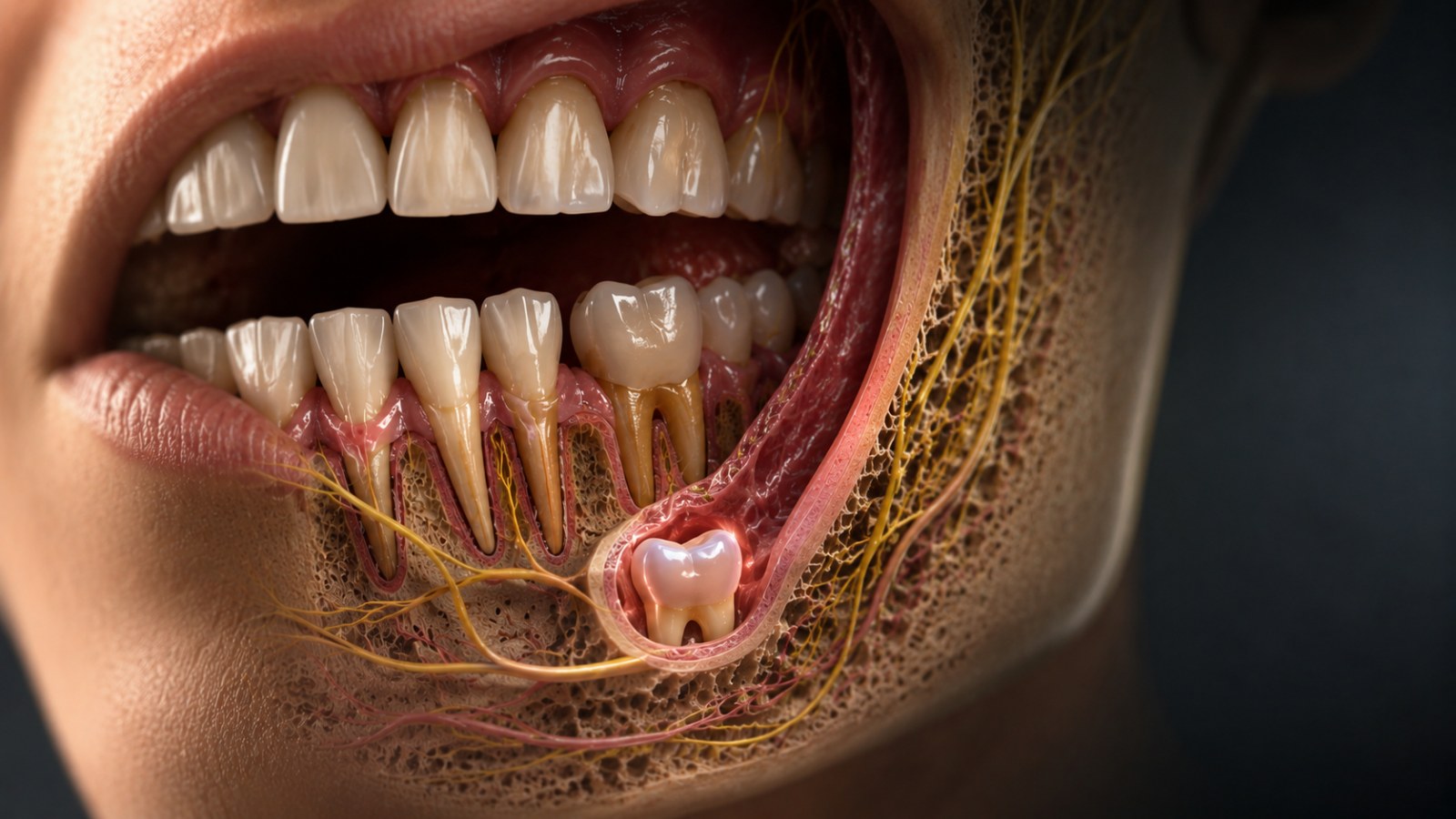
Somewhere inside your jaw, tucked beneath the roots of teeth you've had since childhood, sits a tiny cluster of cells that never got the memo to stop. In most mammals, humans included, these cells are the leftover blueprint of a "third generation" of teeth — a set nature almost gave us, then quietly switched off. For more than a decade, a team at Kyoto University led by Dr. Katsu Takahashi has been trying to flip that switch back on. As of 2026, their work has moved from mouse cages into human volunteers, marking one of the first real attempts to regrow a human tooth from scratch, using biology instead of a drill.
The Brake Pedal Inside Your Gums
Most animals — sharks, for instance — replace their teeth endlessly throughout life. Mammals gave up that trick millions of years ago, settling for just two generations: baby teeth, then permanent ones. But the "reserve" tooth buds for a third set don't fully disappear; they sit dormant, held in check by a protein called USAG-1.
Think of USAG-1 as a foot pressed firmly on the brake pedal of tooth growth. It works by blocking two signaling pathways, called BMP and Wnt, that cells use to build tissue and organs during development. USAG-1 is a bone morphogenetic protein antagonist that plays a vital role in tooth regeneration and is expressed in kidney, gingiva, and dental tissue. As long as USAG-1 is active, those dormant tooth buds stay asleep. Take the brake off, and — at least in mice — they wake up.
Proof It Works: Whole New Teeth in Mice
The pivotal experiment came from Takahashi's group in a landmark 2021 study in Science Advances. The researchers showed that USAG-1 deficiency enhances bone morphogenetic protein signaling, which leads to the formation of extra, supernumerary teeth, and that antibodies interfering with USAG-1's ability to bind BMP could reproduce this effect. Crucially, the antibody didn't just nudge growth along — it worked in mice bred to lack teeth entirely, restoring fully formed tooth structures where none should have existed. The team went on to map exactly where on the USAG-1 protein their antibodies latch onto, pinpointing a specific short stretch of the protein's structure as the key docking site for the most effective candidates.
A companion study the same year, published in Scientific Reports, tested a different tactic: rather than injecting an antibody throughout the body, the researchers applied a short interfering RNA (siRNA) directly to the gum tissue of Runx2-deficient mice, another strain that fails to grow teeth normally. The topical Usag-1 siRNA partially rescued arrested tooth development in these mice, demonstrating that locally applied treatments could also encourage tooth regrowth. Together, the two studies gave scientists two independent tools — a systemic antibody and a local gene-silencing patch — that both pointed at the same underlying brake.
From Mouse Jaws to Human Trials
Encouraged by consistent results across multiple mouse models, the Kyoto team spent the following years preparing a version of their antibody safe enough for people, now known by the code name TRG035. A 2024 paper in the Journal of Oral Biosciences detailed that translational push. The researchers produced anti-USAG-1 neutralizing antibodies as potential therapeutic agents for congenital tooth agenesis, the medical term for teeth that never form, and developed the humanized antibody TRG035 specifically for molecular-targeted therapy aimed at regenerating congenitally absent teeth. The condition affects a meaningful slice of the population — roughly 10% of people are missing up to five teeth from birth (hypodontia), while about 1 in 1,000 are missing six or more (oligodontia), often complicating chewing, speech, and jaw development from childhood onward.
That groundwork led to the milestone dentistry has been waiting for: human testing. A first-in-human Phase I trial of TRG035 began at Kyoto University Hospital in September 2024, initially enrolling adult volunteers to establish that the antibody is safe and well tolerated before efficacy in regrowing teeth is formally assessed. A recent 2026 literature review in Clinical and Experimental Dental Research summarized where the field now stands: engineered monoclonal antibodies targeting USAG-1 have been shown to promote third dentition and alleviate congenital tooth agenesis in preclinical models, and clinical trials of this antibody approach are currently underway, with prospects for commercial application within the next decade.
Why This Isn't Science Fiction — But Isn't Tomorrow, Either
It's worth being clear-eyed about the timeline. No published data yet confirms that a human being has regrown a tooth this way — the current trial phase is about safety, not proof of regeneration in people. Researchers and industry analysts following the program broadly expect that, if later-phase trials go smoothly, an approved therapy is unlikely before the end of the decade, and it would almost certainly launch first as a treatment for congenital tooth agenesis rather than a general replacement for cavities or extractions.
Still, the biological logic is unusually solid for a field long dominated by titanium implants and dentures. Unlike a stem-cell graft or a lab-grown tooth bud that must be surgically placed, USAG-1 blockade works by releasing a natural developmental program the body already carries — essentially convincing dormant cells to finish a job they were built to do. That distinction matters: it could make manufacturing, delivery, and regulatory approval considerably simpler than more invasive tissue-engineering approaches. For anyone who has ever left a dentist's office facing a lifetime of implants or bridges, that quiet cellular brake, and the antibody now poised to release it, represents the most credible path yet to a truly new tooth.