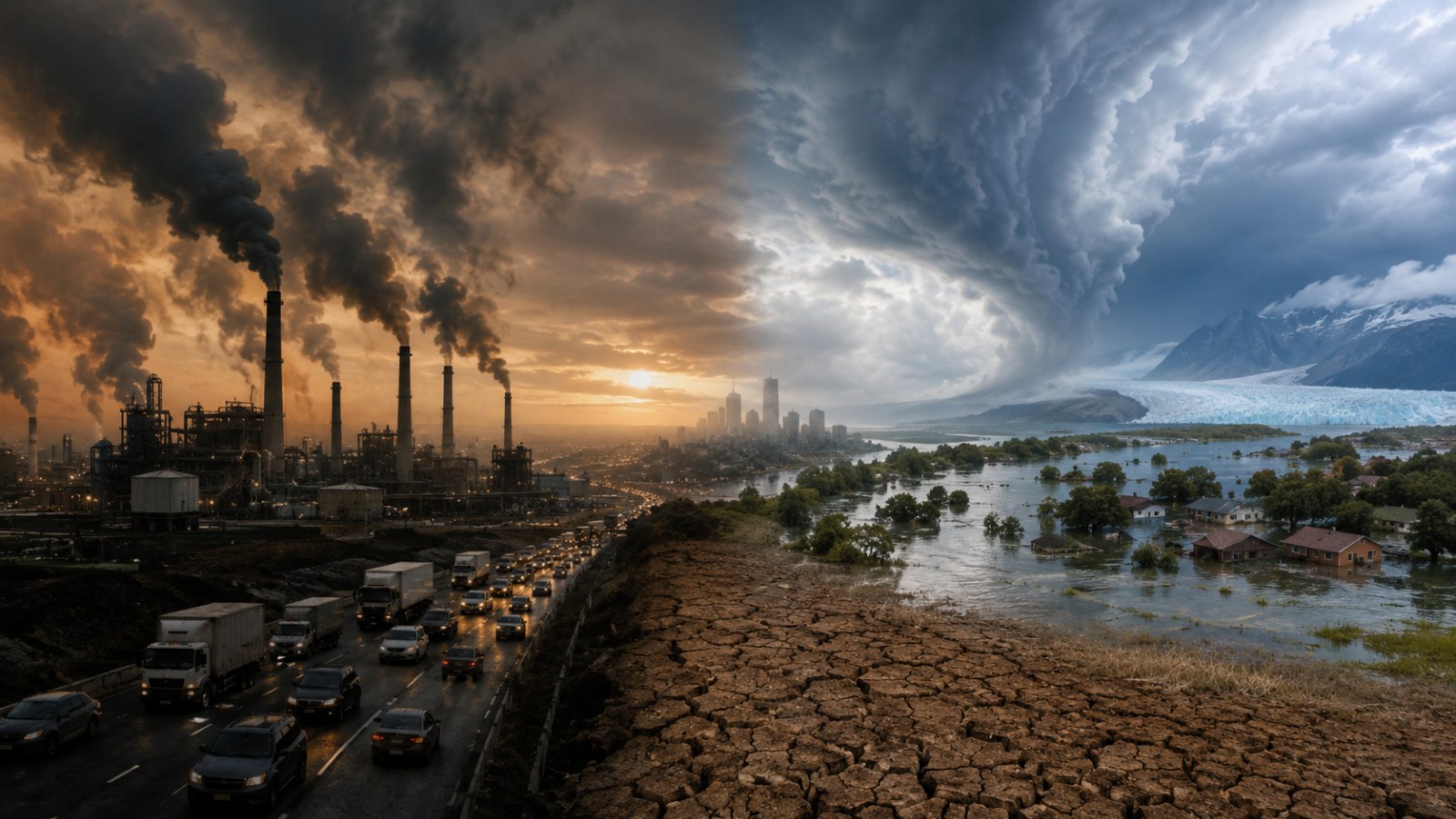
Earth has warmed before. It has never warmed like this.
Ten thousand years ago, Earth thawed out of an ice age on its own — shifting orbits and melting ice sheets did the work, spread across millennia, no factories involved. Every warm or cold spell since has followed a similar pattern: regional, staggered, no two corners of the planet moving in step. A reconstruction of global temperature over the past 2,000 years found that the coldest stretch of the Little Ice Age arrived in the central and eastern Pacific first, reached northwestern Europe two centuries later, and touched other regions later still[1].
The 20th century broke that rule entirely. Nearly the whole planet, 98% of it, warmed together during that century's second half — a level of simultaneous warming with no match anywhere in the preceding two millennia[1]. A separate reconstruction stretching back 24,000 years reached the same verdict from a longer vantage point: both the pace and the scale of today's warming stand apart from anything in that record[2]. Earth's climate has always moved. It has never moved everywhere, together, this fast.
The fingerprint is human, not natural
Assessing ice cores, ocean buoys, tree rings and satellite records together, climate scientists concluded that human influence has, without ambiguity, warmed the atmosphere, the ocean and the land surface[3]. Carbon dioxide concentrations reached 410 parts per million in 2019, methane and nitrous oxide climbed to their own record highs alongside it, and the rise in each since 1750 traces directly back to human activity[3].
Most of that comes from burning coal, oil and gas, but land use plays its own part. Agriculture, forestry and other land use together accounted for 13–21% of global greenhouse gas emissions between 2010 and 2019, and deforestation alone made up 45% of that share[4].
Who's filling the account now, and who filled it before
Picture the atmosphere as a shared account: every tonne of carbon dioxide released sits there for centuries, and someone's name is attached to each deposit. In 2025, the most recent year with published estimates, China deposited the most, projected to account for 32% of global fossil CO2 emissions, though its growth had slowed sharply from the past decade's pace. The United States followed at 13%[5].
India came next at 8%, also growing more slowly than its decade-long trend that year. The European Union held 6%, one of two regions — alongside the United States — where 2025 emissions grew faster than their recent, declining trend[5]. Altogether, fossil fuels were projected to release 38.1 billion tonnes of carbon dioxide over the course of 2025[5].
The account has a history, though, and it tells a different story about who ran up the balance. Tracking cumulative emissions since 1850 against a safe planetary boundary, one analysis found the United States responsible for 40% of the world's excess emissions, with the European Union adding a further 29%[6].
Together with the rest of the industrialised world, that puts the Global North at 92% of the total overshoot. India and China sit at the opposite end, holding the two largest "climate credits" — 35% and 26% — because both have historically taken less from the shared account than their populations were owed[6]. China's position is unusual: the world's largest annual emitter in 2025, and still, by this historical per-person measure, in credit.
The bill falls somewhere else
The countries that filled the account the most are rarely the ones handed the bill. A study matching national emissions against national vulnerability found 20 of the 36 highest-emitting countries ranked among the least exposed to climate impacts, while 11 of the 17 lowest-emitting countries were acutely vulnerable — evidence, the authors argued, that the burden of climate change and the responsibility for it point in opposite directions[7].
The most recent Climate Risk Index, which ranks countries by lives lost and people affected over the past 30 years, places Dominica, Myanmar and Honduras at the top[8]. None of the eleven worst-affected countries is a wealthy, industrialised nation; together they are home to more than three billion people, including India, ranked ninth, and China, eleventh[8].
The scale is already measurable in people, not just rankings. Researchers tracking the share of people living outside the historical "human climate niche" — the narrow temperature band humans have always clustered in — found climate change has already pushed more than 600 million people, about 9% of the world, outside it, with India and Nigeria facing the largest numbers exposed to dangerous heat by 2100 under current policy[9].
The Pacific already amplifies what's coming
El Niño and La Niña, the Pacific Ocean's periodic swings between warm and cool surface waters, are not caused by climate change — they are a natural rhythm with records stretching back millennia. But warming appears to be changing how hard that rhythm swings: modelling across twenty climate models found that greenhouse warming roughly doubles the frequency of extreme El Niño events over the 21st century, from about once every 20 years to once every 10[10].
A related analysis of La Niña, El Niño's cold-water counterpart, projected extreme La Niña events nearly doubling in frequency too, from about once every 23 years to once every 13, if global emissions keep climbing[11].
What happens next, and who could still intervene
Not every emissions trend is climbing. The same 2025 accounting found at least 35 countries, Australia, Germany and New Zealand among them, have cut fossil emissions over the past decade while their economies kept growing[5].
One proposed intervention goes further than cutting emissions: deliberately cooling the planet by reflecting sunlight back to space, often loosely folded into talk of "China's" climate work. An analysis of who could actually carry this out found roughly ten countries have the technical means, built around fleets of a hundred or more specialised high-altitude aircraft, but only the United States and China combine the technical and geopolitical weight to deploy it unilaterally, over the objections of others[12]. Nothing at that scale has been attempted; it remains a proposal, not a deployed technology.
Modelling the difference between pathways found that holding warming to 1.5°C, instead of the 2.7°C current policies imply, would leave roughly five times fewer people exposed to unprecedented heat by century's end[9]. That gap, between what is already locked in and what is still being decided, is what sits behind a shifting monsoon, a worst-affected-cities list, or a classroom question about who is responsible.