Rain has a sweet spot, not just a direction
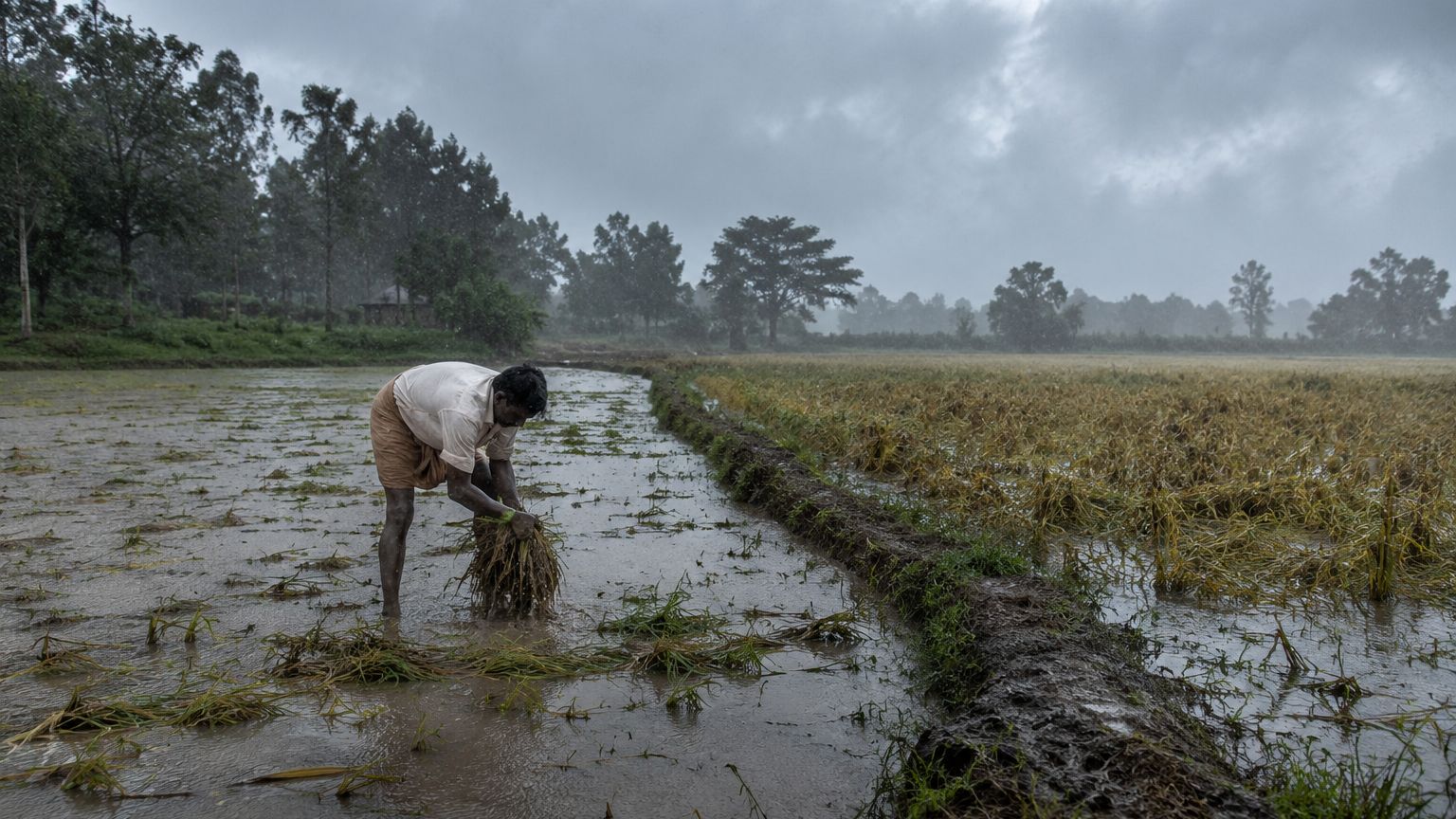
Most farmers are told to hope for more rain. A nationwide study of Kharif monsoon rice across India from 1990 to 2017 found that this advice runs out well before the monsoon does[1]. Rice yield climbs as rainfall increases, but only up to a threshold of about 1,621 mm of growing-season rainfall nationwide; beyond that point, every extra 100 mm costs the crop roughly 6.4 kg of yield per hectare[1]. Below the threshold, the crop is even more rain-hungry — every 100 mm of missing rainfall costs about 17 kg per hectare[1]. Think of rainfall less as a tap you simply open wider and more as a dial: turned too little or too far past the right notch, the harvest suffers either way.
That single number, however, hides enormous variation. The district-level analysis found the ideal rainfall threshold ranges from just 544 mm in Haryana to 2,775 mm in Kerala, tracking each region's typical rainfall[1]. A rainfall total that would flood a Haryana rice field is barely adequate in Kerala. There is no single "good monsoon" number a farmer can memorise nationwide — only a dial position specific to where they farm.
Too much water can hurt worse than too little
Across India as a whole, the same study found that extreme wet conditions cut rice yield by 33.7%, compared with a 19% loss under extreme dry conditions — excess rain did more damage than drought[1]. The imbalance was sharper in some states than others. Once rainfall passed the local threshold, the sensitivity of yield to extra rain was strongest in Kerala, followed by Maharashtra, West Bengal and Karnataka[1]. In a country where flood warnings tend to get less attention than drought warnings, this matters: for rice in these particular states, a wet monsoon can be the more dangerous one.
Same rain, different crop, opposite outcome
Rain does not treat every crop the same way, even in the same district. District-level data from Odisha covering 2001 to 2018 found that a given deviation in rainfall dragged down long-term yield by 0.16% for wheat but by 0.48% for green gram — three times the damage for the same rainfall swing[2]. Stranger still, the short-term picture flips for some crops: green gram, black gram and groundnut all showed a positive short-term response to weather variability in the same dataset, even though the long-term trend for related pulses was negative[2]. A single rainy season can look like good news for a pulse crop and still add up to a loss over several years.
A separate nationwide analysis of rice, pearl millet (bajra), chickpea, groundnut and sugarcane, using seasonal rainfall and evapotranspiration data, found thresholds specific to each crop and each season. Groundnut yield turns downward once monsoon rainfall passes about 397 mm[3]. In autumn, yields of rice, groundnut and sugarcane each decline once rainfall exceeds roughly 129 mm, 425 mm and 255 mm respectively, while bajra and chickpea yields fall as autumn rainfall rises at all[3]. In winter, rice and sugarcane yields rise with rainfall only up to about 85 mm and 89 mm, after which more rain starts working against them[3]. Five crops, five different tipping points, all within the same growing calendar.
Some crops are built to ride out a dry spell
Not every crop needs the dial tuned precisely. An analysis of rainfall variability and major crops in Karnataka, a largely rainfed state, found that kharif sorghum, rabi sorghum and cotton showed a statistically significant linear trend under deficient rainfall — with the trend line's slope significant in 46%, 73% and 57% of cases respectively — while several other crops in the same dataset showed far less sensitivity to the swings[4]. The same analysis singled out chickpea as unusually drought-hardy, able to draw soil moisture from close to the permanent wilting point, the condition under which most plants can no longer extract water from the soil at all[4]. Not every crop punishes a farmer for a missed monsoon — some are built for exactly that risk.
The crop you plant can add to the risk or absorb it
That distinction has played out at scale in Marathwada, one of Maharashtra's most drought-prone regions. Cropped-area records from 1998 to 2015 show a shift there: acreage under sugarcane, cotton and soybean in the kharif season, and wheat and chickpea in the rabi season, rose while acreage under drought-resilient staples such as sorghum fell[5]. Modelling of how each crop's yield responds to growing-season rainfall in the region concluded that this shift — away from sorghum and pearl millet and toward water-intensive cash crops such as sugarcane and soybean — is an imprudent choice that can worsen production losses when the rains fall short[5]. The rainfall didn't change the risk here so much as the cropping pattern did.
What this means at planting time
None of this points to a single "best" crop for Indian farming — the studies above disagree with each other in exactly the way real regional variation demands, and that disagreement is itself the finding. What they agree on is that the dial has a right position, that position is different from district to district and crop to crop, and that some crops are simply more forgiving when rainfall lands off target. For a farmer choosing between a thirsty cash crop and a hardier traditional one this season, the district's own rainfall history — not last year's headlines about a good or bad monsoon nationally — is the number worth checking first.